
Home Case study
Orion and Nexus
How we built and ran a shared AI platform for Mod Op.

At Mod Op, I led product and technical direction for Nexus with the six-person product and engineering team I managed. It began as the account and configuration service for Mod Heat, with a requirement that later products could use the same foundation. It grew to hold shared knowledge and agents, with Nexus Chat giving the agency a workspace to use them and Nexus MCP connecting them to external tools. By the public launch of Orion in July 2026, Mod Op reported that 95% of its nearly 500 employees had adopted the platform.
A note on names: Mod Op's public materials use Mod Engine and Mod Chat, and the portfolio became Orion in July 2026. Inside the team, the platform was Nexus and its workspace was Nexus Chat. Those are the names I use here.
Where we started
In 2024, teams across the agency were building chat tools, agents, image workflows, and other AI experiments. Each project had its own login, its own copy of client information, and its own decisions about access. A new project often repeated setup work another team had already done.
Mod Heat, Innovation's first product release, gave us an opportunity to address that. We made a shared foundation a requirement for its first version. I wanted each product we shipped to leave behind capabilities the next one could use.
Mod Heat scans news, industry sources, and social media each day, then evaluates signals for individual clients. Each client needed its own view and configuration, informed by that client's agency data. We held confidential strategy, research, and unreleased work, so the access boundaries had to be clear to the people building products and to the people using them.
The AI processing also cost enough that it needed careful per-client configuration. Some people needed permission to set up the service and incur costs. Others only needed to use it. Together, those requirements described a service that connected a user to a client organization and carried the right configuration and access rules into the product. That service became Nexus.
What I owned
I set the product boundary, worked through the access model with the team, and decided which capabilities belonged in Nexus. I also worked with UX, data science, transformation, and agency leadership on priorities and rollout. The products we were building gave us specific requirements for the shared service. Each chapter below marks one of those moments, when a product needed a capability and we chose to build it once for everyone.
01 · Foundation
Nexus shipped alongside Mod Heat in November 2024. Mod Heat handled its own signal processing. Nexus handled user accounts, client details, and each client's product configuration.
We could have kept those functions inside Mod Heat. We chose a separate service, so that identity, permissions, and approved company knowledge were platform capabilities from the start and later products could use them as they took shape.
One early application was the agency's required AI foundations course. The training system was another Mod Op product. Connecting its user accounts to Nexus let us gate access to every tool in our portfolio behind course completion, which is how the agency's responsible-use policy was enforced.
Later, when I built Launchpad in February 2026, it used the same sign-in from its first morning. Employees could try the prototypes from that spring's two hackathon sprints with the accounts they already had, and engineers could share their builds across the agency without setting up authentication for each one.
02 · Agents and knowledge
Brand Agents are assistants with a brand's approved material already in place: strategy, voice, audience, and current context. They began as part of Mod Heat, supplying the knowledge that made a moment's score meaningful and grounding the concepts it generated. At first those agents ran on OpenAI's Assistants API, outside Nexus.
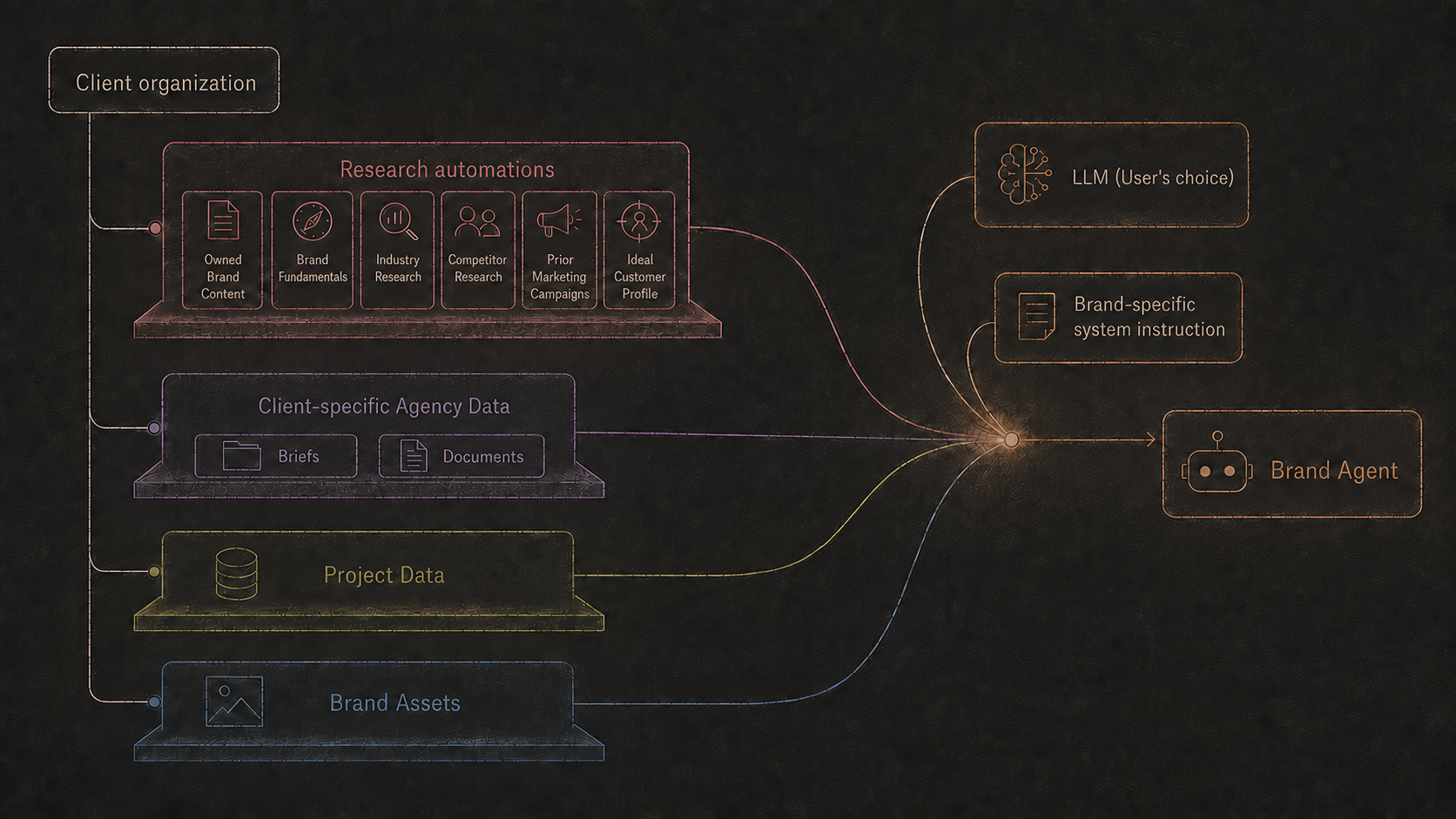
In 2025, we moved Brand Agents and their retrieval system into Nexus, managing the agents and vector stores through the platform. They came under Nexus's access rules, and agents became a general capability: anyone at the agency could create one, chat with it, and manage or share it with teammates. We launched Brand Agent internally in April 2025 with more than a dozen client-specific agents and iterated on their deployment over the next two quarters.
The first major upgrade was Knowledge Layers: collections of approved material at the company, brand, or project level. Teams could attach new kinds of data to an agent or point several agents at the same layer, so knowledge could be reused and updated without editing every agent separately. Layers carried their own confidentiality and agent-access controls. An agent could draw on broadly shared company knowledge and restricted client material at the same time, with permissions governing each.
We kept canonical brand facts by hand and used automations to keep research layers current, drawing on curated web sources and Perplexity. In early 2025, most assistants knew nothing about the brand you were working on, and certainly nothing about unreleased work. A colleague opening a Brand Agent started with that context already assembled, including approved material no public search could reach. Automating the research is what let the library grow without constant upkeep.
There were more than 50 client-specific Brand Agents by June 2025 and coverage for every active client by December. By Orion's July 2026 launch, Nexus hosted more than 700 agents of all types.
03 · Workspace
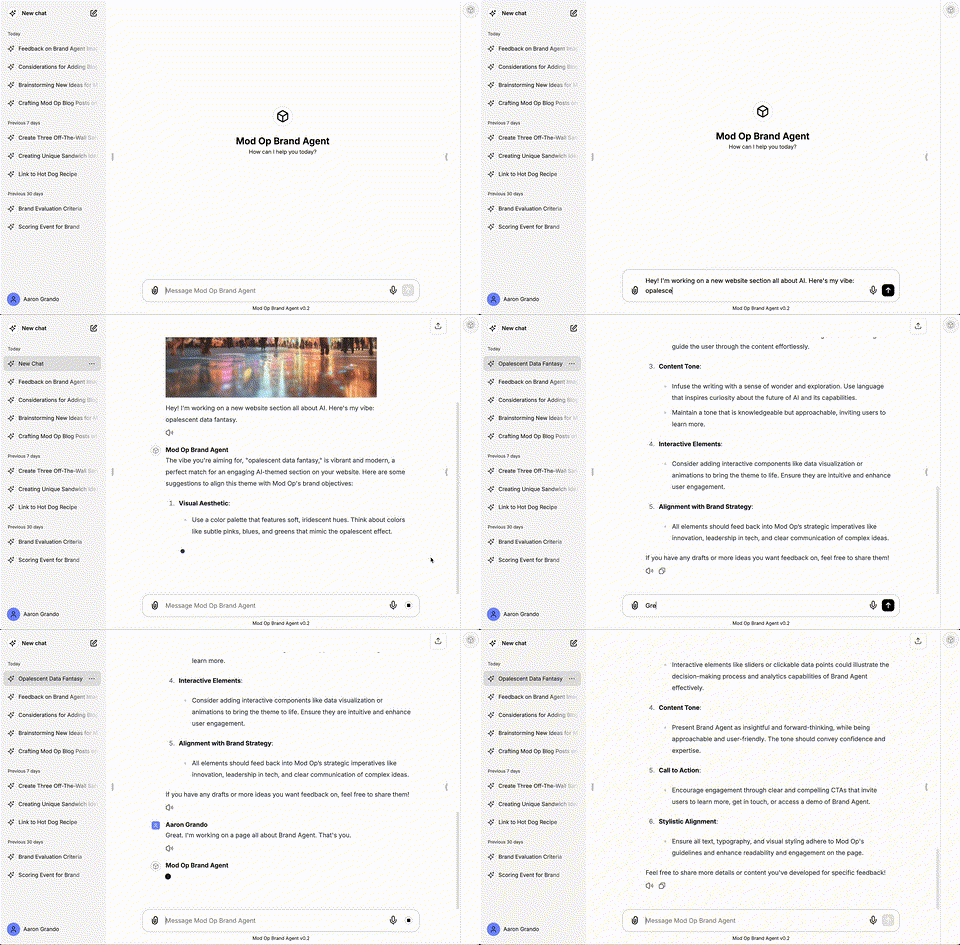
Most people met Nexus through chat. The first version, Mod Chat, was a customized prerelease build of an open-source chat interface with Nexus sign-in. We rolled it out to the whole agency in March 2025, just ahead of Brand Agents. It gave everyone access to OpenAI's chat models through the API without an individual subscription for each of nearly 500 employees.
As models became more capable of using tools and taking actions, we wanted to extend the workspace without waiting on the open-source project's roadmap. Innovation engineer Javier Lopez prototyped a chat interface inside Nexus, close to the agents and organization data it needed. Nexus Chat entered beta that summer.
Image generation was one of the first tools we added beyond choosing a model or an agent, and it became one of the platform's most-used features. It consolidated a scatter of shared accounts and subscriptions into one cost center where usage could be traced and reviewed.
We added chat and image models as they were released. People could choose a model, but we set defaults so they did not have to follow every release themselves, and there was no per-seat usage cap. Keeping models current and broadly available was part of how the workspace kept earning return visits.
Custom tools followed. The Time Tracking Agent, released in November 2025, could read a person's work calendar and write to NetSuite, the agency's booking and time-tracking system. Someone could describe their week in plain language and have the agent draft their timesheets from their calendar and assignments. We reported a drop in average weekly time on the task from more than an hour to under 20 minutes. I used it every week myself, which made it an easy place to check whether the product was helping.
I treated adoption as an ongoing product responsibility. Models and competing chat apps kept improving, and people had reasons to try them. I planned Nexus Chat on a three-to-six-month horizon, making room for capabilities that were becoming practical while keeping the workspace familiar to the people already using it.
04 · Usage and value
Usage counts alone would not tell us whether Nexus was working, so we built a daily classifier and scorer. It evaluated each conversation for whether the person completed their task, sorted the work into a taxonomy of agency use cases, and estimated the time a person would have needed to do the successful ones by hand. That gave us usage by person, team, and task, a modeled labor value for the work completed, and a clear view of what to improve or build next.
Usage grew every month during the platform's first year. At Orion's July 2026 launch, adoption stood at 95% of employees, with a large share of the agency active in Nexus Chat in any given month. The retention analysis showed that people used Nexus more the longer they had used it.
By summer 2026, the modeled labor value of work completed in Nexus Chat had passed $3M (an estimate derived from conversation analysis, not measured payroll savings or revenue). Separately, Digiday reported roughly $3M in avoided subscription costs across Orion in August 2026.

05 · External tools
Early in 2026, we considered extending Nexus into a coding and desktop agent environment. Tools such as Claude Code and Codex were handling long, multistep tasks, and our own team was using them. We discussed forking an open-source agent environment, as we had with the original Mod Chat.
We decided to keep Nexus focused on chat. Making a broader agent environment available across the agency would have meant ongoing work to run it securely and keep it current, while the vendors shipped major upgrades every few weeks. We would have been committing the team to maintaining an alternative alongside them.
That decision meant some of Nexus Chat's heaviest users would move their most demanding work to those tools. Our job was to help the agency do its work, even when that moved activity out of our own product. So we supported the transition instead of trying to keep every task in Nexus. We onboarded heavy users to coding agents when they reached Nexus's limits, and for those users a subscription cost less than the volume of usage-based API calls they had been making. By August 2026, about 20% of the agency had adopted Claude workflows, the subscription count stayed manageable, and Nexus Chat kept growing as the place for shared knowledge and company tools.
People using external tools still wanted Nexus knowledge in them. During the second Launchpad sprint in March 2026, I wrote the specification for a Nexus integration using MCP, the Model Context Protocol, and Javier Lopez built it. A person adds the integration to a compatible tool and authorizes through Nexus with a single click. The tool then gets read-only access to the company and client knowledge that person is allowed to see, along with agent data and the moments Mod Heat has surfaced. The platform's existing permissions apply throughout.
We made the integration read-only at first so we could ship it quickly with a limited scope. A connected tool could retrieve data but could not write back to Nexus through that connection. What it did with the information was up to the tool, which opened up automation work outside our chat interface.
Becoming Orion
Mod Op launched Orion publicly on July 28, 2026. It brought Nexus together with Brand Agents, Mod Heat, Audience Lab, GEO, Launchpad, and other parts of the agency's technology portfolio. I owned six of those products and helped shape the Orion story that spring.
The portfolio was not assembled from the top down. It was prioritized from the agency-wide listening tour I led in late 2025 and tested as Launchpad prototypes, with feedback from staff and clients, before anything moved to MVP. Nexus remained the shared foundation, so new products started with identity, permissions, and approved context already in place.
What I learned
Let the live product decide what goes in the platform. We built Nexus because Mod Heat needed accounts and configuration in November 2024, and every layer after that was pulled in by a product with users. The parts that lasted were the ones no single model release could replace: identity, permissions, knowledge, and measurement.
What we needed to build changed as the tools around us improved. We had good reasons to build our own chat workspace in 2025 and different reasons to connect external agent tools in 2026. In both cases the work that mattered was the client knowledge and the access controls underneath, and knowing which side of that line a capability sat on was the product decision.
Links
- Brand Agent Mod Op product page · public overview of the agent pattern.
- How We Created AI That Actually Helps Clients Mod Op launch article · the thinking behind the client-facing Brand Agent.
- Micro-tools Could Turn Everyone into a Builder Mod Op article · the rapid internal tools pattern around Nexus.
- Say ‘Hello’ to Brand Agent: AI That Speaks Your Brand’s Language Leader Generation podcast · Brand Agents and persistent brand context.
- Building Your Army of AI Agents: What Marketers Need to Know Leader Generation podcast · agents, delegated access, and MCP.
- Beyond Prompts: Better AI Outputs With Context Engineering Leader Generation podcast · context as a product and systems problem.
- Mod Op Unveils Orion: A Connected Intelligence Platform Redefining the Creative Agency Model for the AI Era Mod Op press release · public launch on July 28, 2026.
- Build or Buy? Inside Indie Agency Mod Op’s AI Infrastructure Digiday · August 2026 coverage of the platform investment and build-versus-buy decision.